How to Choose the Right Electric Brushed Motor for Your Needs?
Choosing the right Electric Brushed Motor can significantly impact your project's success. According to industry expert Dr. Anna Lin, "Selecting the right motor is crucial for performance." Her insight reflects the importance of understanding specific needs and applications.
Electric Brushed Motors are widely used in various applications, from toys to industrial machines. Each motor has unique specifications which can affect efficiency and durability. Choosing incorrectly can lead to suboptimal performance or even failures in your application. It’s essential to consider factors like voltage, torque, and size before making a decision.
Furthermore, many users struggle with these choices. They often overlook crucial details or focus solely on price. This can lead to remorse later on. Understanding the specifications and how they relate to your needs will help avoid these pitfalls. An informed choice can enhance your project’s effectiveness, ensuring that the Electric Brushed Motor meets your requirements seamlessly.

Types of Electric Brushed Motors and Their Applications
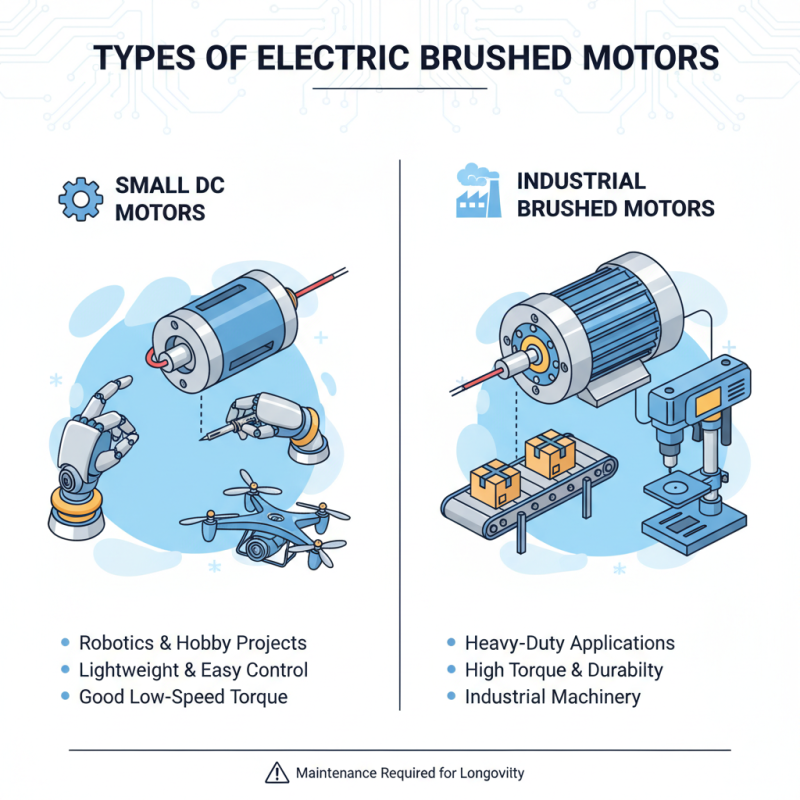
Electric brushed motors come in various types, each suited for specific applications. For instance, small DC motors are ideal for robotics and hobby projects. They are lightweight and easy to control. These motors provide good torque at low speeds. However, they can wear down faster if not properly maintained.
Another common type is the universal motor. It can run on both AC and DC power, making it versatile. These motors are often found in household appliances. They can provide high speed and power in compact sizes. Yet, their carbon brushes may require frequent replacement, leading to maintenance challenges.
Stepper motors are also important. They offer precise control and are widely used in 3D printers and CNC machines. They move in defined steps, allowing for accurate positioning. On the downside, they can struggle with speed and may consume more power than expected. Each motor type has distinct advantages and limitations. Understanding these can guide you to make informed choices.
Key Factors to Consider When Selecting an Electric Brushed Motor
Choosing the right electric brushed motor involves several key factors. Understanding these aspects can improve your project efficiency and performance. One crucial consideration is the motor's voltage and current requirements. High voltage often means more power and speed, but also requires careful handling. Lower voltages can be safer but limit performance.
Another important factor is the motor's torque. Ensure you assess the torque needs of your application. If your project involves heavy loads, opt for a motor with higher torque output. It's often a balancing act between speed and torque, so weigh your options.
**Tips**: Always test the motor under actual conditions. This can help reveal any potential issues. Additionally, consult with professionals or reliable resources if you're uncertain. Compare specifications from multiple sources to ensure you make an informed choice. Sometimes, a less powerful motor may perform adequately while consuming less energy. Always remain open to refining your choices based on feedback and results.
How to Choose the Right Electric Brushed Motor for Your Needs?
| Parameter |
Description |
Example Values |
| Voltage Rating |
The operating voltage required by the motor. |
6V, 12V, 24V |
| Current Rating |
The maximum continuous current the motor can handle. |
2A, 5A, 10A |
| RPM (Revolutions per Minute) |
The speed at which the motor operates. |
3000 RPM, 6000 RPM, 12000 RPM |
| Torque |
The rotational force produced by the motor. |
0.5 Nm, 1.5 Nm, 3 Nm |
| Size/Dimensions |
The physical dimensions of the motor. |
50mm x 100mm, 60mm x 120mm |
| Duty Cycle |
The ratio of operating time to non-operating time. |
40%, 60%, 100% |
Understanding Voltage and Current Ratings for Electric Motors
When selecting an electric brushed motor, understanding voltage and current ratings is crucial. Voltage affects the speed and power of the motor, while current determines its torque and overall performance. A motor with a higher voltage rating can achieve greater RPM, but it requires a compatible power supply. If mismatched, the motor may underperform or fail.
Tips: Always check the voltage requirements for your application. A too-high voltage can damage components. A too-low voltage may result in inefficiency. Knowing the specific needs ensures a more reliable operation.
Current ratings are equally important. Higher current ratings usually mean more torque. Yet, this could lead to overheating if not appropriately managed. Pay attention to the motor's specifications to avoid burnout.
Tips: Monitor the current draw during operation. If it exceeds the rating, reassess your setup. Over time, this might lead to unexpected failures. Understanding and adjusting for these metrics can significantly improve the longevity and efficiency of your motor.
This chart shows the voltage and current ratings for different electric brushed motors. The first dataset represents the voltage ratings while the second dataset indicates the current ratings. Understanding these values is crucial for selecting the appropriate motor for your application.
Assessing Performance Requirements: Torque, Speed, and Efficiency
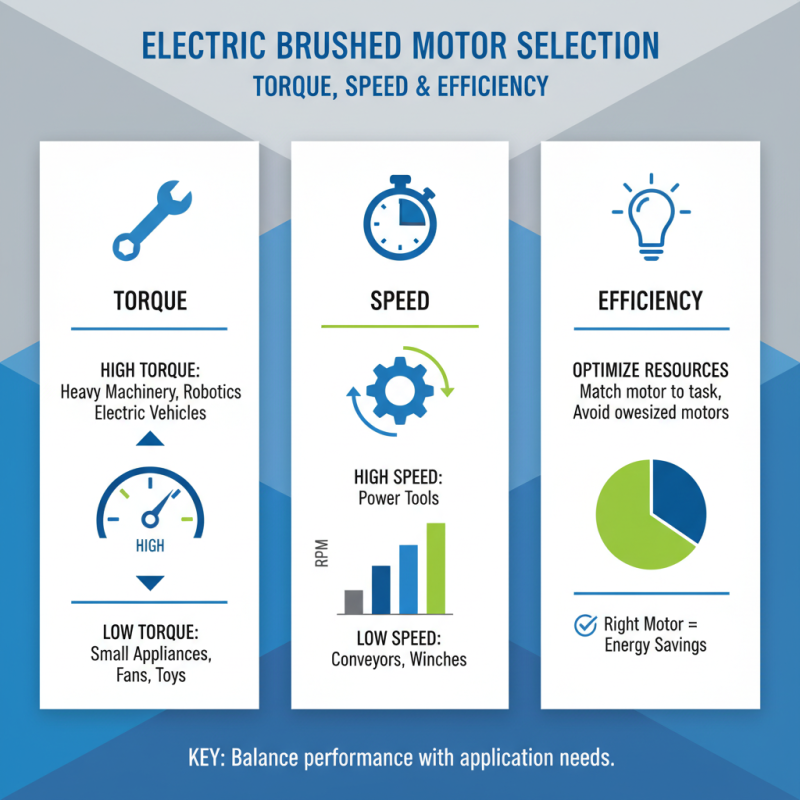
When selecting an electric brushed motor, it’s crucial to evaluate the performance requirements. Torque plays a significant role in determining how much load the motor can handle. A higher torque is essential for demanding applications like heavy machinery. On the other hand, low-torque tasks might not require high-performance motors, which could lead to inefficient use of resources.
Speed is another key factor. It dictates how fast the motor operates. High-speed motors can achieve faster results, but they may compromise on torque. Finding a balance between speed and torque is vital. To achieve optimal performance, consider the specific needs of your project.
Tips: Always review the specifications carefully. Understand the operational conditions. If you're uncertain, consult with experts to gain insights. This helps in making informed choices. Also, don't overlook the efficiency rating. A more efficient motor saves energy and reduces operational costs. Reflection on these factors can lead to better purchasing decisions and ultimately a more effective application.
Common Mistakes to Avoid When Choosing an Electric Brushed Motor
Choosing the right electric brushed motor can be challenging. Many people overlook important specifications. One common mistake is ignoring
torque requirements. Selecting a motor with inadequate torque can lead to performance issues. Understand the load your
motor needs to handle. This helps prevent frustration down the line.
Another mistake is failing to consider voltage ratings. Motors operate at specific voltages. Using the wrong voltage can damage the motor or hinder performance.
Be aware of the power supply available and match it with the motor’s rating. It's vital to pay attention to these details.
Users often underestimate the importance of
size and weight. A motor that's too large may not fit in the intended application. Conversely, a small motor might not provide
the desired power. Always measure your available space before finalizing your choice. Recognizing these details can significantly enhance your performance and satisfaction with the product.